In depth
Concrete Slab Lifting in San Antonio: how the job actually runs
Concrete slab lifting raises sunken concrete from underneath instead of replacing it. Polyurethane foam or a cement slurry is pumped through ports drilled in the slab, fills the void under it and lifts it back to level in hours. In San Antonio the usual candidates are patios that dropped away from the house, driveways with a step at the garage, sidewalks and pool decks, and the occasional garage or interior floor section that sank over fill. It is a different job from piers under a house, and the first thing the evaluation does is tell the two apart, because they cost very different money and fixing the wrong one fixes nothing.
Why slabs sink here
Exterior concrete is poured on fill placed when the house was built, and the fill keeps settling for years. On the clay side of the metro the soil under a patio shrinks in a dry August and the slab drops at the edge away from the house, where the soil dries first, so the patio tilts away and a gap opens at the wall. On the limestone north side, in Shavano Park, Garden Ridge and Boerne, long driveways, patios and pool decks sit on fill pads that settle toward the low side of the lot. Water finishes the job: a downspout that ends on the patio, a broken sprinkler line under the driveway, or a plumbing leak under a garage floor washes the fine soil out from under the slab and leaves a void. Tree roots, especially live oaks in Hollywood Park and the older neighborhoods, lift walks and pool decks the other way.
Lifting or piers
| What you see | Usually means | Answer |
|---|---|---|
| Patio, stoop or walk dropped away from a level house, gap at the wall | The slab settled on its own | Lift it |
| Driveway with a step at the garage apron, or a section holding water | Fill settled or washed out under that section | Lift it |
| Garage or interior floor section sunk, crack with a step, grade beam level | Fill under that section settled or washed out | Lift it, locate cables first on post-tension |
| Patio level, house dropped, brick open above the door | The foundation moved | Piers, not foam |
| Interior high in the middle, edges low, cracked tile over a bath | Leaking drain heaving the interior | Plumbing repair and survey, not foam |
| Walk or deck with a raised edge on the tree side | Root lift | Cut and reset, or root barrier and lift the low side |
The level survey reads both the sunken slab and the structure it meets. A patio two inches below a level house is a lifting job. A house two inches below its patio is a pier job, and a good share of San Antonio lots have one of each, with the proposal listing them separately.
Foam or slurry
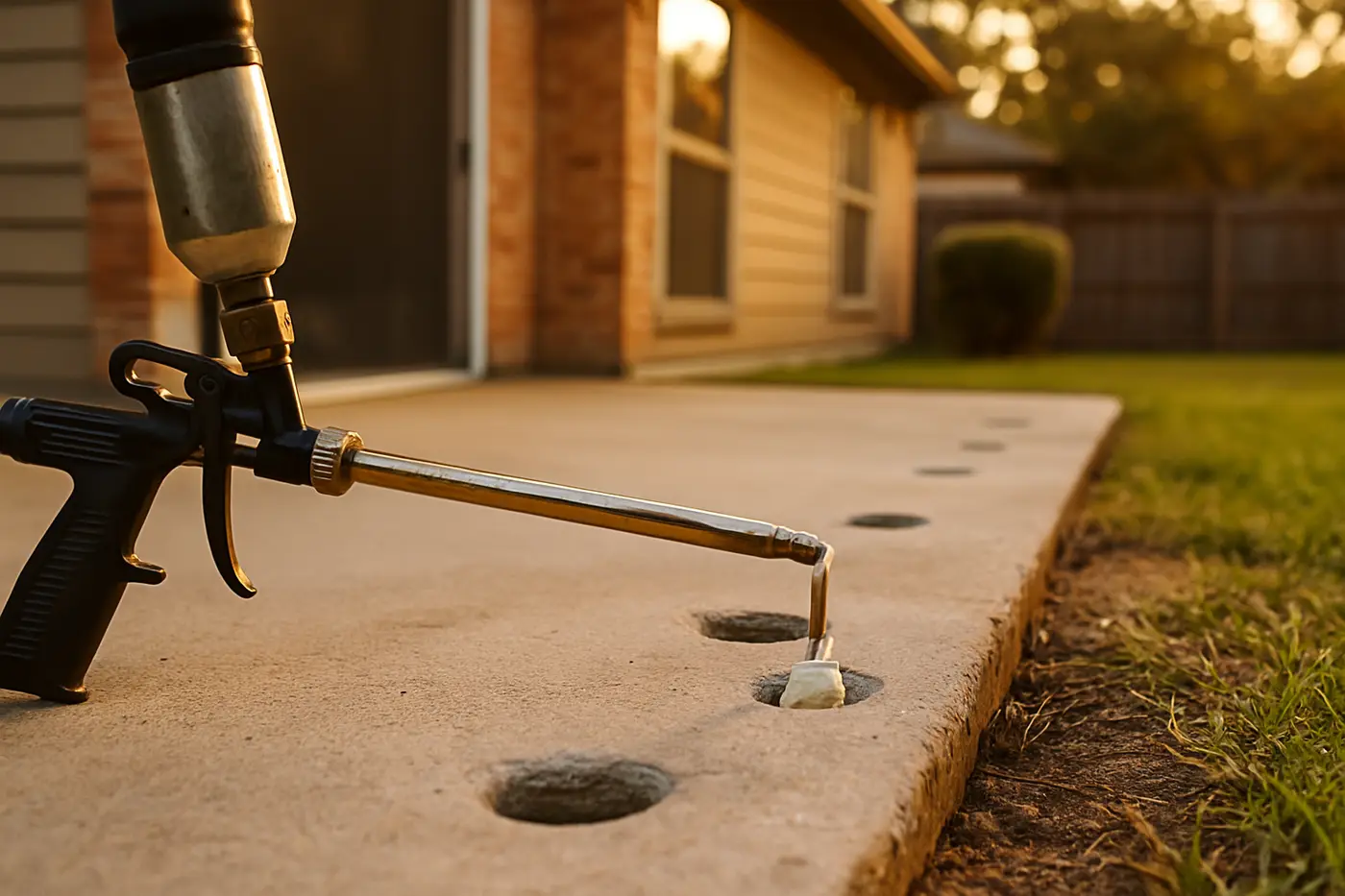
Polyurethane foam is injected as a liquid through ports about the size of a dime, expands under the slab, fills the void and lifts. It cures in minutes, weighs almost nothing, does not absorb water or shrink, and does not add load to soil that is already settling. It suits interior floors, garage slabs, patios, stoops and anything against the house, and it costs $1,500 to $6,000 per area.
Mudjacking pumps a cement and soil slurry through larger ports, lifts the same way, and costs $600 to $3,000. It weighs more, takes longer to cure, and can erode or settle if water keeps running under the slab, which is why a mudjacking that dropped again within a few years is a common call. It suits driveways, walks and large exterior slabs where cost per square foot matters more than weight.
Both are undone by the same water that dropped the slab if the drainage is not fixed at the same time, so the proposal pairs the lift with the downspout extension, the grading or the leak repair that caused it, on the drainage correction basis.
The lift
Ports are drilled through the slab in a pattern set by the size of the sunken area and where the void is. Foam or slurry is pumped under it, the void fills first, and then the slab starts to rise. The lift is done in stages with a level on the slab and someone watching for cracking, because a slab lifted too fast at one end cracks in the middle. When the slab meets the structure or reads level, the ports are patched, joints against the house are caulked so water stops running into the gap, and the area is usable within the day. On a post-tension house slab the cable layout is located before any drilling. Cracks that are now level across are injected with epoxy or polyurethane afterward if you want them bonded or sealed, on the crack repair basis, and that is cosmetic unless the cause is fixed.
What it costs
Polyurethane foam slab lifting $1,500 to $6,000 per area. Mudjacking $600 to $3,000. Crack injection after the lift $300 to $1,500. Gutters and downspout extensions where water caused the drop $1,200 to $4,000. If the survey shows the house rather than the slab has moved, pressed concrete pilings run $350 to $600 each with most homes needing 8 to 12, and that is a separate proposal explained in the cost guide. Every number goes in writing after the evaluation, with the method, the number of ports and what is and is not covered.
While you wait
Photograph the gap at the wall with a tape measure in the shot and the date. Find where the water goes: a downspout on the patio, a sprinkler head that floods the driveway edge, a hose bib that drips onto the walk. Move the downspout today if you can. If the sunken slab is inside the house, note whether the doors near it stick and whether the floor is high anywhere else, because that changes the diagnosis. Then send the form with the neighborhood and what has sunk, and you will get an evaluation window and a written line on whether it is a lift or a pier plan, with the watering advice for the clay around it.
Last updated September 03, 2026