- #pressed-pilings
- #steel-piers
- #drilled-piers
- #helical-piers
- #methods
- #san-antonio
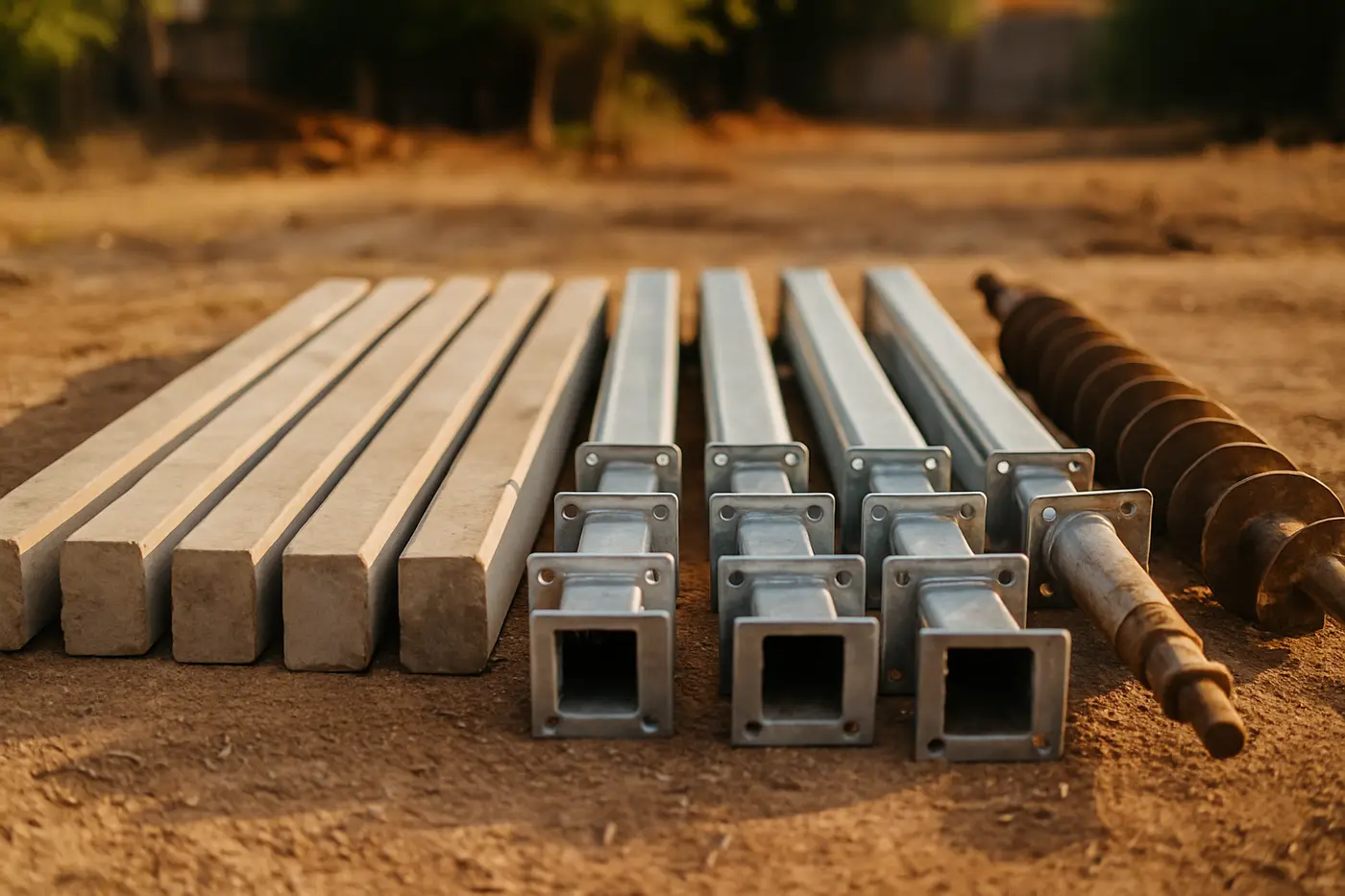
Pressed concrete pilings, pressed steel piers, drilled bell-bottom piers and helical piers are the four ways to put a pier under a San Antonio house, and the soil picks between them more than the contractor does. Pressed concrete pilings, at $350 to $600 per pier, suit the deep Blackland clay south and east of the Balcones fault. Pressed steel piers, at $1,000 to $1,800, suit the limestone north and west where pilings refuse within a few feet. Drilled bell-bottom piers, at $1,200 to $2,200, go in to an engineer’s plan under heavy structures. Helical piers, at $1,500 to $3,000, suit additions, pier and beam homes and anywhere vibration must stay low. Most homes need 8 to 12 piers of whichever kind, and a good proposal names the method and says why the soil under your address suits it.
Pressed concrete pilings
How they go in. A hole is dug beside the grade beam at each location, about two feet square and deep enough to get a hydraulic press under the beam. A 12-inch precast concrete cylinder is set in the hole and pressed down into the soil, using the weight of the house as the reaction. Another cylinder goes on top and is pressed, and another, until the stack will not go further: refusal. A cap block goes on the stack, the house is lifted with jacks and shimmed onto the cap, and the hole is backfilled.
Where they work. Deep clay. Across Schertz, Cibolo, Converse, Universal City, Live Oak, the south side and the east sides of New Braunfels and Seguin, the Blackland clay runs deep enough that the stack reaches refusal below the zone that swells and shrinks with the seasons, and the piered section stops moving. They are fast, a crew can set a dozen in a day or two, and they are the lowest cost per pier in the metro.
Where they do not. Shallow rock. North and west of the fault, in Stone Oak, Helotes, Boerne, Garden Ridge and parts of Shavano Park, the stack hits limestone or caliche within a few feet and refuses before it has any real depth, which is a pier sitting on the same uneven rock the slab already sits on. That is where the plan moves to steel.
Pressed steel piers
How they go in. The same hole and the same press, but the pier is a steel pipe in sections that are pressed one after another, threaded or sleeved together, and driven deeper and more predictably than concrete cylinders can go, through mixed soil, caliche and fill until they reach a consistent bearing or rock.
Where they work. The limestone side, mixed lots, fill pads, and anywhere pilings refuse early. Rock gives a firm bearing quickly, so a steel pier on the north side is often shorter than a piling on the south side, and the count is often lower for the same movement. They also suit a slab that has settled on a cut-and-fill pad in Alamo Ranch or Helotes, where the pier has to pass through loose fill to find something solid.
The cost. $1,000 to $1,800 per pier, two to four times a concrete piling. In deep clay that premium buys little; on rock it buys the difference between a pier that holds and one that does not. On a mixed lot the proposal uses both.
Drilled bell-bottom piers
How they go in. A drilling rig bores a hole, typically 10 to 20 feet deep, and a belling tool widens the bottom into a bell shape that spreads the load over more soil. A reinforcing cage goes in, concrete is poured, and the pier cures before the house is lifted onto it. Each pier is a known diameter at a known depth with a known bell, which is why engineers like them.
Where they work. Wherever an engineer’s plan calls for them, and under weight: commercial buildings, multi-story homes, heavy masonry, and repairs where a Texas licensed Professional Engineer has specified the capacity. They have the longest track record of the engineered methods in Texas.
The trade-offs. $1,200 to $2,200 per pier, a rig in the yard, spoil to haul, and days of cure time before the lift, so a job that takes two days with pilings takes a week or more with drilled piers. A typical single-story slab on clay usually does not need them; a job with twenty piers on an engineer’s plan often does.
Helical piers
How they go in. A helical pier is a steel shaft with one or more helix plates near the tip, screwed into the ground with a hydraulic drive head like a giant screw. The torque it takes to turn rises as the soil gets firmer, and the torque reading indicates the capacity the pier has reached, so each one is verified as it goes in. It does not need the weight of the house to install.
Where they work. Light structures that cannot supply the reaction a pressed pier needs: a porch, a room addition, a garage, a beam in the crawl space of a pier and beam home. Anywhere vibration must stay low: a masonry wall shared with the neighbor downtown, a stone building on Hauptstrasse in Boerne or in Castroville’s historic core, a house with a plaster interior that cannot take a press. And soft soil where a concrete footing will not hold.
The cost. $1,500 to $3,000 per pier, the highest of the four, and worth it where the alternative is a pressed pier that cannot be installed or a masonry wall that cracks.
The comparison
| Pressed concrete pilings | Pressed steel piers | Drilled bell-bottom piers | Helical piers | |
|---|---|---|---|---|
| Cost per pier | $350–$600 | $1,000–$1,800 | $1,200–$2,200 | $1,500–$3,000 |
| Installed by | Pressing with house weight | Pressing with house weight | Drilling, belling, pouring | Screwing to torque |
| Depth | To refusal in clay | To bearing or rock | 10–20 ft, belled | To torque |
| Time | Hours per pier | Hours per pier | Days, plus cure | Hours per pier |
| Best soil | Deep clay | Shallow rock, mixed, fill | Any, engineered | Any, soft soil |
| Suits | Northeast, south, I-35 clay | Stone Oak, Helotes, Boerne, Garden Ridge | Commercial, heavy, engineer’s plans | Additions, pier and beam, shared walls |
| Weakness | Refuses early on rock | Cost in deep clay | Slow, rig in the yard | Cost |
What the soil under your address says
The Balcones Escarpment runs through the metro from southwest to northeast along I-35, US 281 and Loop 1604. Below it, deep clay: pilings. Above it, limestone: steel. Along it, in Alamo Heights, Shavano Park, Hollywood Park and the transition band, a single lot can be both, and the elevation survey plus a soil probe tell the crew where the rock is before the count is drawn. Why the two sides move differently is in why San Antonio homes have foundation problems, and the slab foundation repair page walks through the install.
What a good proposal says
It names the method and the reason. “Pressed concrete pilings, because the soil boring and the neighborhood put this house on deep clay” or “steel piers, because pilings on this street refuse at three feet.” It draws the pier locations on a floor plan with the count. It includes a hydrostatic plumbing test before and after on an older slab. It says who pulls the permit and whether an engineer’s report is available. And it states the warranty terms in writing. A proposal that names a method without a reason, or that quotes the most expensive method on deep clay without explaining why, is worth a second opinion, which is the subject of how to choose a foundation repair company in San Antonio. The per-pier numbers above are typical 2026 San Antonio ranges from the cost guide, and the number for your house is the one on the plan.